

Key Takeaways
- Finance AI chatbot development can enable businesses to improve their operational efficiency and customer service.
- The AI Chatbot Architecture needs to be secure and compliant to handle sensitive data.
- It becomes easy to figure out threats with AI in fraud detection.
- The best finance AI chatbot is secure, measurable, integrated, explainable, and aligned with business KPIs.
- Solulab can help finance leaders with secure fintech chatbot development for banking operations.
Finance leaders are seeking news of generating measurable value with AI. In 2026, finance AI chatbot development is becoming a boardroom priority because customer service, compliance, fraud detection, onboarding, advisory, and back-office workflows are all under pressure. Customers expect instant answers. Regulators expect control. Leaders expect cost reduction. Teams expect better tools.
Recent reports suggest that AI chatbot development could improve productivity in financial services, with banking operations improving efficiency. This guide highlights the growing demand for AI chatbot development in finance and how financial institutions can build intelligent banking assistants for conversion in 2026.
Understanding Finance AI Chatbot Development and Its Role
When deploying finance AI chatbot for business, it must be able to answer, guide, verify, automate, and escalate with accuracy across regulated financial conversations.
This involves the process of designing, training, and deploying AI-powered solutions for financial firms and payment platforms.
While traditional bots had limited usage, custom financial AI chatbot solutions take advantage of LLM to answer product questions, guide transactions, support users , flag fraud, and assist teams. These systems can be connected banking systems, CRM, KYC tools, payment gateways, ticketing platforms, policy documents, and compliance workflows to act like controlled service layer between the customer, the employee, and the bank’s operating system.
How AI Chatbots Are Used in Banking Today?
Banking chatbots now support sales, service, operations, compliance, and risk teams instead of only handling generic FAQs.
The question is no longer simply how AI assistants are used in banking. The stronger question is how they reduce operational drag while increasing customer conversion.
Banks use AI chatbots to manage balance queries, card support, account information, payment disputes, branch information, loan status, KYC steps, product education, document collection, and complaint routing. Competitor research also shows that banking chatbot content commonly highlights 24/7 support, real-time answers, cross-selling, and operating cost reduction.
For leaders, the value is in the operating model. A chatbot can handle high-volume, low-complexity questions while human agents focus on disputes, exceptions, complaints, high-value customers, and regulated judgment. Gartner also notes that intelligent virtual assistants and advanced search can reduce routine inquiries reaching human agents.
This improves time management, resource management, and customer experience at the same time. Instead of hiring more people for repetitive volume, banks can redeploy skilled employees toward revenue, retention, and risk control.
Use Cases of AI Chatbots in Fintech That Drive ROI
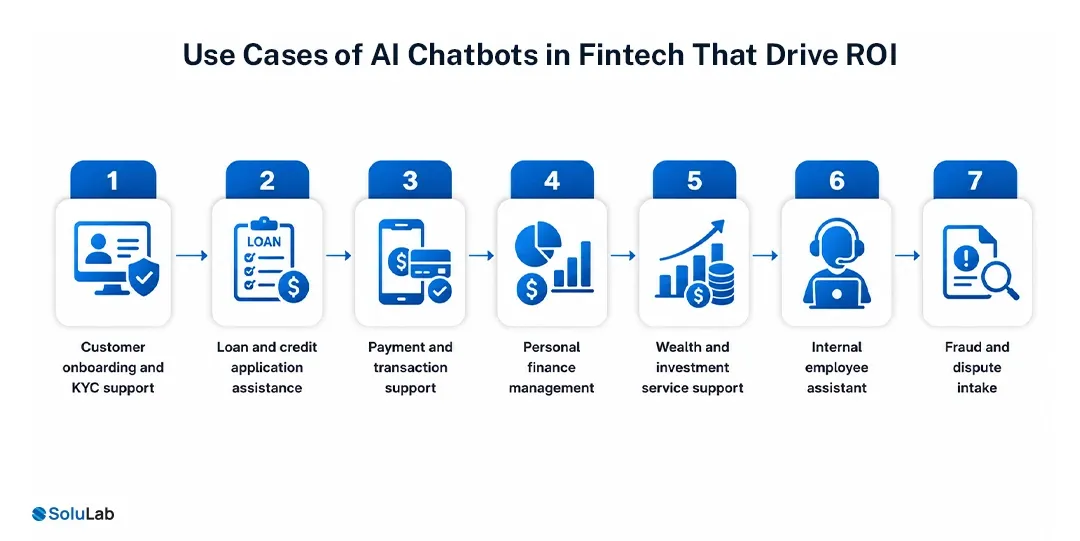
The AI development for Finance can help to improve the conversion without increasing headcount. They are intermediaries between the customer intent and operational friction. Some of the high-impact use cases include:
- Customer onboarding and KYC support
Chatbots guide users through account opening, collect missing documents, answer eligibility questions, and reduce onboarding drop-offs.
- Loan and credit application assistance
An AI assistant can explain loan products, pre-check basic eligibility, collect information, and route qualified leads to sales or underwriting.
- Payment and transaction support
Customers can ask about failed payments, pending transfers, card issues, charges, and transaction history without waiting for an agent.
- Personal finance management
An AI chatbot for personal finance management can help customers understand spending, budgets, savings goals, reminders, and financial habits.
- Wealth and investment service support
Chatbots can explain product categories, collect risk profile inputs, book advisor calls, and provide approved educational content.
- Internal employee assistant
Staff can use AI development solutions to search policies, summarize customer history, draft compliant responses, and reduce time spent switching systems.
- Fraud and dispute intake
AI assistants can collect fraud reports, freeze workflows based on rules, escalate urgent cases, and reduce response time.
These use cases directly affect cost per interaction, conversion rate, customer lifetime value, and service capacity.
How Secure Are Finance AI Chatbots in 2026?
Finance chatbots are secure only when security is designed into data, model, workflow, and AI integration layers. Many leaders ask, how secure are finance AI chatbots? The answer depends on the design. A secure chatbot is not created by adding encryption at the end. It requires security from the first architecture decision. A banking-grade chatbot should include:
- Strong user authentication
- Role-based access control
- Data encryption in transit and at rest
- Secure API gateways
- PII masking and tokenization
- Prompt injection protection
- Data retention rules
- Audit logging
- Human approval for sensitive actions
- Continuous monitoring
- Model risk controls
- Compliance-ready reporting
PCI DSS v4.0.1 is now the active PCI standard after PCI DSS v4.0 retirement, and PCI guidance continues to focus on protecting payment account data and clarifying technical and operational requirements. NIST also released a Generative AI Profile to help organizations identify and manage unique generative AI risks.
Security should also include third-party risk management. Reuters reported that financial regulators are concerned about AI oversight gaps, concentration risk, and reliance on a small group of AI consulting providers. The best finance AI chatbot is the one that can deliver value without creating uncontrolled operational, privacy, compliance, or reputational risk.
How To Choose The Best AI Chatbot Solutions for Finance?
The best solution is not always the most advanced model; it is the safest model that improves business outcomes. When evaluating the best AI chatbot solutions for fintech companies, leaders should avoid buying technology before defining value. A strong solution must answer four questions.
- What business problem will it fix?
- The data it will need?
- Which workflows will it touch?
- How will success be measured?
Fintech app development services usually include everything from the discovery to ongoing support. Choose the company that has
- Industry experience.
- Support secure integrations
- Execute compliance-sensitive workflows
- Strong prompting skills
- Clear escalation.
- ROI tracking
- Post-launch optimization
- Transparent development process.
Finance leaders should also decide whether they need a customer-facing chatbot, employee assistant, agentic workflow system, or a full AI service platform. The answer affects scope, timeline, budget, and risk.
How To Choose an AI Chatbot Development Company for Banking?
The right partner must understand financial workflows, regulated data, risk controls, and measurable business outcomes. An enterprise AI chatbot development company for banking must do more than write prompts. It must understand operating models, financial products, customer journeys, integration points, risk policies, and compliance obligations.
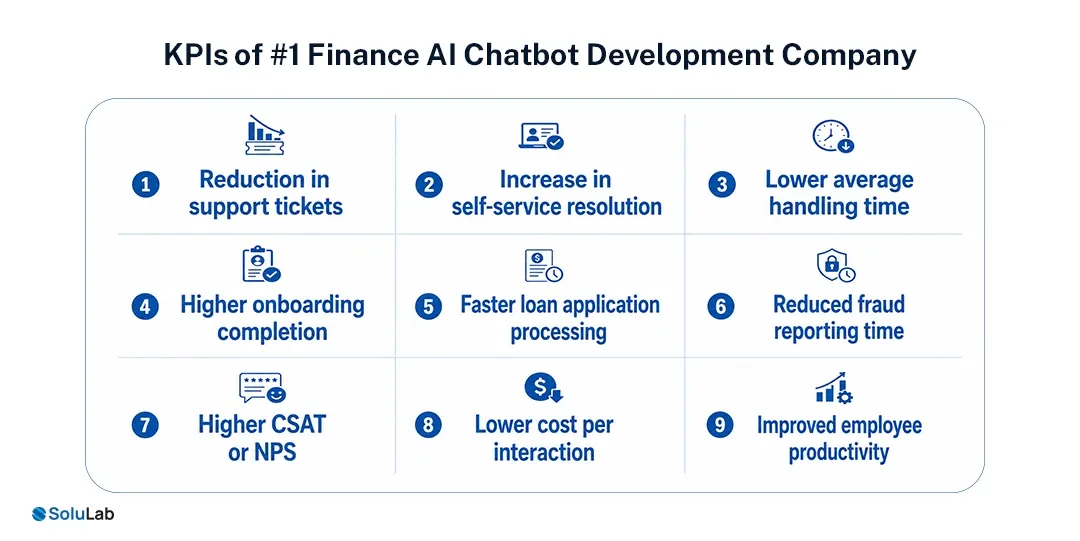
Common KPIs include:
- Reduction in support tickets
- Increase in self-service resolution
- Lower average handling time
- Higher onboarding completion
- Faster loan application processing
- Reduced fraud reporting time
- Higher CSAT or NPS
- Lower cost per interaction
- Improved employee productivity
This is how ROI becomes visible. The chatbot should not be judged only by message volume. It should be judged by the financial and operational outcomes it improves.
AI Chatbot for Finance ROI: Operations, Cost, and Resource Management
A well-built chatbot can reduce repetitive customer inquiries, shorten service queues, improve first-contact resolution, reduce manual data entry, and support agents with better context. It can also help sales teams convert customers by answering questions at the moment of intent.
The ROI appears in several places:
- Faster execution of business operations and quicker response time.
- Reduced cost for every interaction.
- Minimal human dependency.
- Efficient task completion.
- Resource and time management
We recently developed an AI-powered chatbot for a travel-based client that upscaled the business within a few weeks. Read our full case study, Digital quest to get in the detailed view of what we did and how.

How Solulab Helps Build Finance AI Chatbots That Convert?
Solulab helps you identify high-ROI chatbot use cases, design secure AI workflows, build customer-facing and employee-facing assistants, integrate them with business systems, and measure performance after launch.
With Solulab, #1 AI development company in USA, you can move from idea to production with a practical roadmap that covers discovery, architecture, compliance planning, AI model selection, workflow automation, testing, launch, and optimization.
Build Your Finance AI Chatbot With Solulab!
FAQs
A finance AI chatbot helps the financial industry to ease their day-to-day business operations by providing support to execute tasks faster.
Banks use AI chatbots for accounting, answering customer queries, completing KYC, providing the loan updates, reporting frauds every day.
Yes, they are safe for customers to use if the development is using secure encryptions and it supports features authentication, access control, and human approval rules properly.
Choose an AI chatbot development company that understands the legal, technical, and operational requirements, and is able to deliver measurable ROI.
