

The crypto wallet space is evolving fast. Founders are now exploring PWA Bitcoin Wallets as they are lightweight, install-free apps that blend the best of web and native experiences. A PWA (progressive web apps) Bitcoin wallet loads instantly, works offline, and can be added to a phone like a real app, making it a smart move for any crypto product team.
| PWAs boost retention up to 3x, and mobile crypto usage has jumped 150% in two years. |
Brands like NC Wallet and Ka.app are already scaling with progressive web app Bitcoin wallet models because they’re faster, cheaper, and more secure to maintain.
At Solulab, we’ve built everything from PWA development MVPs for wallets to enterprise-grade blockchain platforms. In this guide, we’ll cover what a PWA Bitcoin Wallet is, why it’s better than a native app, how to build it securely, and real examples you can learn from.
What is a PWA Bitcoin Wallet?
A PWA Bitcoin Wallet is a new, smarter way to build a crypto wallet for Bitcoin. Instead of downloading an app from the App Store or Play Store, users can simply open a link in their browser and install the wallet directly from the web. It looks and works like a normal mobile app, but it runs inside your browser.
A progressive web apps Bitcoin wallet uses modern web tech like service workers and web manifests to make it fast, reliable, and secure. It can even work offline or on a weak internet connection, allowing users to check balances or queue transactions anytime.
From a business view, a progressive web app Bitcoin Wallet gives you the best of both worlds:
- The reach and speed of a website
- The experience of a native app
That means:
- No app-store approval delays
- Automatic updates for all users
- Lower development and maintenance cost
- Faster user onboarding
In simple words, if your user can open a link, install it to their home screen, and use it even when offline, that’s the power of a PWA Bitcoin Wallet. This model is now gaining popularity among crypto startups and payment companies that want to launch global wallets more quickly without the usual app-store headaches.
How Does a PWA Bitcoin Wallet Work?
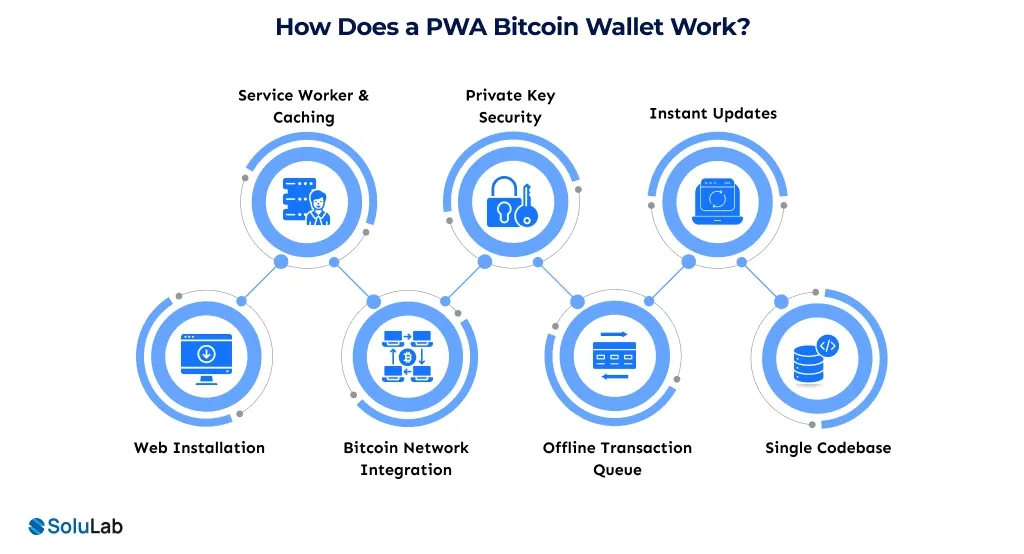
A PWA Bitcoin Wallet is a browser-based crypto wallet that behaves like a mobile app. It combines the reach of the web with the speed and feel of a native application, but without app store restrictions. Here’s how it actually works behind the scenes
1. Web Installation
When a user visits your wallet website, the browser reads two key components: a web manifest and a service worker.
- The manifest tells the browser how the wallet should appear (icons, name, theme).
- The service worker runs in the background to handle caching, notifications, and offline access.
Together, they enable users to add to Home Screen, turning your progressive web app Bitcoin wallet into an installable app without the App Store. This makes onboarding extremely fast, users can open your PWA Bitcoin wallet app directly with one tap.
2. Service Worker & Caching Logic
The service worker is the real engine of the wallet. It intercepts network requests, caches blockchain data, and enables offline-first behavior. Here’s what happens technically:
- When a user opens the wallet, the service worker checks if data (like recent transactions or balances) exists in cache.
- If offline, it loads the cached version instantly.
- If online, it fetches live data from your backend or node API, then updates the cache in the background.
This means even in low connectivity zones, your PWA Bitcoin wallet still feels responsive and usable.
3. Bitcoin Network Integration
Inside the wallet, your progressive web app Bitcoin Wallet connects to a Bitcoin full node or a lightweight SPV client. This connection allows it to:
- Fetch balances and transaction history.
- Build and sign transactions directly in the browser.
- Broadcast signed transactions to the Bitcoin network.
For instant payments, you can integrate the Lightning Network, which adds payment channels for near-zero-fee transactions. That’s how advanced wallets like NC Wallet or Ka.app offer fast Bitcoin transfers using PWA wallet development technology.
4. Private Key Security
Private keys are where real ownership lies. In a PWA Bitcoin Wallet, keys are generated locally inside the browser using secure APIs such as WebCrypto. They’re stored safely in the user’s device memory or encrypted local storage, never on your central servers.
You can add advanced protection using:
- AES-256 encryption
- Hardware wallet integration (Ledger/Trezor)
- Biometric authentication (Face ID, fingerprint)
This ensures users maintain full custody of their Bitcoin, while your app still feels light and easy to use.
5. Offline Transaction Queue
Here’s where PWA architecture really shines. If the user tries to send Bitcoin while offline, your wallet can queue the transaction securely. Once the connection returns, the service worker automatically pushes it to the blockchain.
This offline queue is a game-changer as it gives your progressive web apps Bitcoin wallet development an edge in emerging markets where internet access isn’t consistent.
6. Instant Updates and Zero Downtime
Because it’s web-based, you can deploy new features, bug fixes, or security patches instantly, without waiting for App Store reviews. The next time a user opens your wallet, the latest version loads automatically through the service worker cache update.
This reduces downtime, improves security, and lets your product evolve faster, a major plus for growing teams investing in PWA wallet development.
7. Single Codebase Across All Devices
A PWA Bitcoin wallet app runs on mobile, desktop, or tablet using the same codebase (usually built with React, Vue, or Flutter Web). That means lower engineering costs and faster go-to-market timelines.
From a business point of view, this is why many startups and exchanges are now choosing progressive web apps Bitcoin wallet architecture, it’s more efficient, scalable, and easier to maintain than separate iOS and Android builds.
Why Build a Bitcoin Wallet as a PWA Instead of a Native App?
If you’re building a crypto solution, one big question is, should we build a native app or a PWA Bitcoin Wallet? From a business point of view, this choice affects your cost, speed, reach, and long-term growth. Let’s break it down in simple terms.
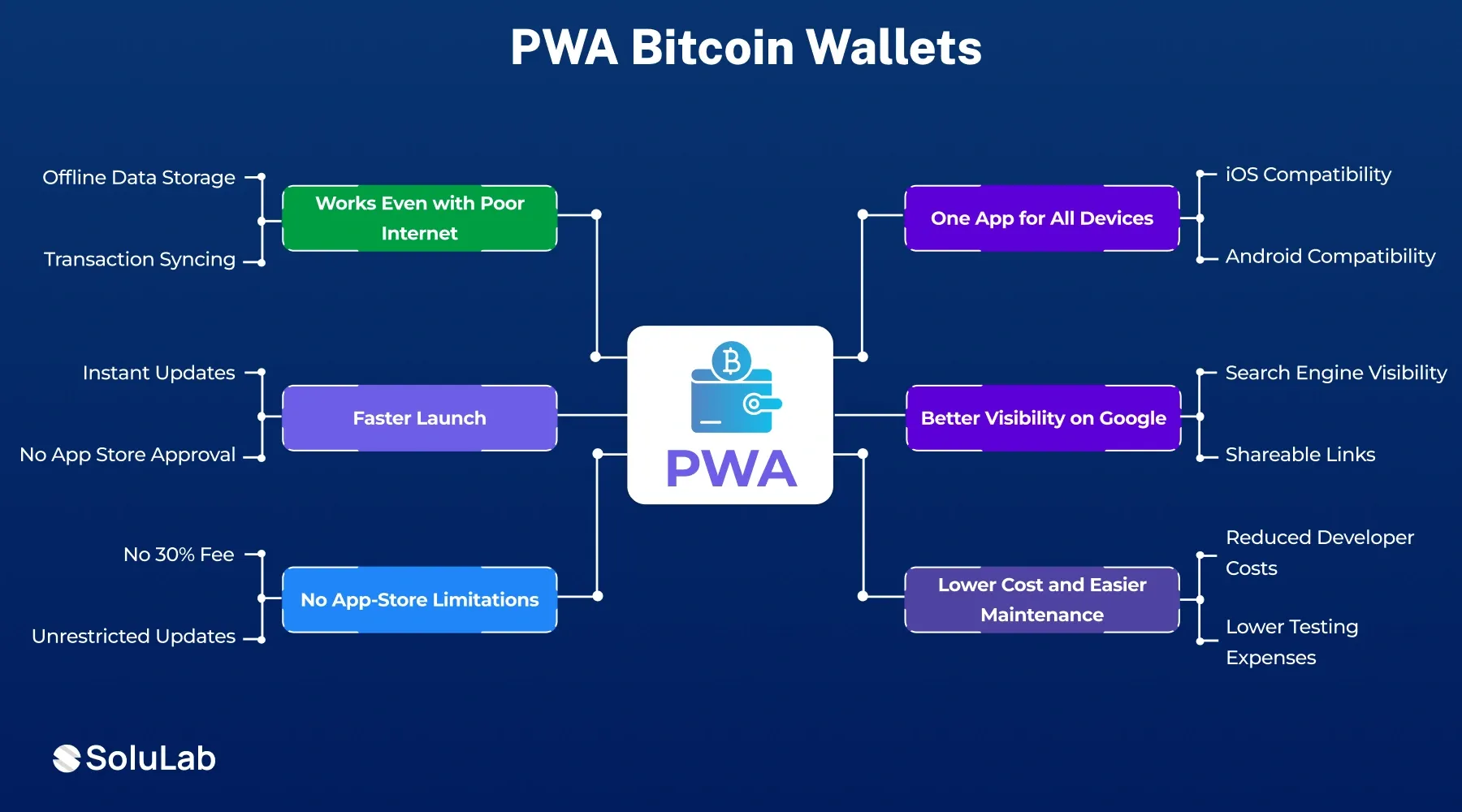
1. Faster to Launch
A PWA Bitcoin Wallet (or progressive web app Bitcoin wallet) lets you go live much faster. You don’t have to wait for App Store or Play Store approvals; you can push updates instantly from your server. That means your product can reach users the same day you launch.
2. One App for All Devices
With a PWA Bitcoin wallet, users can open their wallet on any device, likea phone, laptop, or tablet, just by using a browser. No need to build separate versions for iOS and Android. This helps your team save time and focus on improving features instead of maintaining multiple apps.
3. Lower Cost and Easier Maintenance
Building and maintaining one web-based wallet instead of two or three native apps means huge savings. You spend less on developers, testing, and app-store fees. Over time, this makes PWA wallet development more cost-effective and future-proof.
4. Better Visibility on Google
Because a crypto wallet app on blockchain is still a website, it can show up in Google search results. People can share it with a link, install it directly from their browser, and use it just like an app. That’s free organic marketing, something native apps can’t do as easily.
5. No App-Store Limitations
App stores often take a 30% fee and can reject updates for unclear reasons. With a progressive web app Bitcoin wallet, you skip that entire process. You stay in full control of your product and release new versions anytime.
6. Works Even with Poor Internet
Many users in global or emerging markets don’t always have stable internet. A PWA wallet solves that. It can store data offline, sync transactions later, and let users still see their balances. That’s a big win for adoption in countries with unreliable networks.
7. A Fair Comparison
Of course, native apps still have some perks like better access to phone hardware (for example, NFC or fingerprint sensors) and visibility in app stores. But if your main goal is to reach more users quickly, lower your costs, and stay flexible, a PWA Bitcoin Wallet is the smarter choice.

What Are KYC and AML Rules for Bitcoin Wallet Apps?
When you build a PWA Bitcoin Wallet, compliance becomes just as important as the features you ship. Many founders focus only on UI, speed, or performance, but if you plan to launch globally, you must follow KYC (Know Your Customer) and AML (Anti-Money Laundering) rules from day one.
Most countries treat crypto wallets that hold user funds as financial institutions, whether you are building a PWA Bitcoin wallet app, a progressive web app Bitcoin Wallet, or any other form of PWA wallet development. Because of this, your wallet must include a few essential compliance steps:
- Identity verification (ID cards, passports, or selfie checks)
- Transaction monitoring for unusual or risky behaviour
- Activity logs and proper data storage
- Reporting systems for alerts or suspicious actions
These steps not only keep you compliant but also build user trust. People want wallets that feel safe and reliable.
Rules change from region to region, so your system must be flexible. For example, India is planning new crypto rules in 2025, including mandatory cybersecurity audits for wallets and exchanges. In global markets, you must follow FATF guidelines, which ask you to track risks, create alerts, and report suspicious activities.
If your goal is to take your PWA wallet into the US, EU, Middle East, or Asia, you should build compliance into your architecture early. Adding it later becomes costly and slows your launch.
If your wallet is non-custodial, the rules may be lighter because the user holds the seed phrase, not the company. But compliance still matters. You need safe onboarding, security warnings, clean user flows, and a system that can adapt as regulations evolve. Many countries are now reviewing non-custodial wallets too, so it’s smarter to prepare for future rules now instead of rushing later.
From a business point of view, KYC and AML are not extra tasks. They decide whether your wallet can scale, enter regulated markets, or attract investors. If you want your progressive web app’s Bitcoin wallet or even a specialised wallet like a Fantom PWA wallet to grow smoothly, compliance must be part of your product roadmap from the start.
As a crypto development agency, we help founders design these systems correctly, KYC-ready flows, AML dashboards, secure user journeys, and flexible compliance layers that support long-term growth. This gives your product the foundation it needs to launch with confidence and avoid regulatory problems later.
PWA Bitcoin Wallet vs Native App: Which is Right for You?
When you are deciding how to build a wallet, you usually compare two paths, a Native App Wallet (built separately for iOS and Android) and a PWA Bitcoin Wallet (a Progressive Web App Wallet that works on any device with the web).
| Factor | PWA Bitcoin Wallet (Progressive Web App Wallet) | Native App Wallet |
| Time to Market | Fast. One codebase for all devices. | Slow. Separate builds for iOS & Android. |
| Development Cost | Low. One team, one stack. | High. Two teams, two stacks. |
| Updates & Maintenance | Instant updates. No app-store wait. | Slow updates. App-store approval required. |
| Discoverability | Easy to share. Works from any URL. SEO-friendly. | Harder. Users must search in app stores. |
| Offline & Low Network Support | Strong offline ability using service workers. | Good but depends on device features. |
| Device Hardware Access | Decent but limited (varies by browser). | Full access to sensors, NFC, biometrics. |
| Compliance & App Store Rules | Less friction. No store restrictions. | More rules, high review risk. |
Real Examples of PWA Bitcoin Wallets That Succeeded
Seeing real success stories helps you understand why many founders choose a PWA Bitcoin Wallet instead of a native app. Here are two simple case studies that show how PWAs improve speed, user growth, and onboarding.
1. MyEtherWallet (MEW)
MyEtherWallet (MEW) lets users install their wallet as a PWA, which makes it feel like a native app without downloading anything.
Why they used a PWA:
- Faster onboarding
- No app-store delays
- Works on any device
- Light, quick, and auto-updated
This shows that a progressive web app Bitcoin wallet can scale to millions of users and still stay simple.
2. Fantom Ecosystem Wallets
Several community wallets in the Fantom ecosystem built PWA versions that run fast even on mobile browsers.
Why it worked well:
- Fantom’s high speed with PWA’s lightweight design
- Updates ship instantly
- Works smoothly without installing an app
This shows PWAs fit perfectly for chains where speed matters.
Future of PWA Bitcoin Wallets
The future of PWA Bitcoin Wallets is growing fast, and this is the right time for companies to build one. The wallet market is expanding, users are shifting to mobile, and businesses want products that are fast to build, easy to maintain, and ready to scale globally. A PWA Bitcoin Wallet gives all of that.
Here are simple numbers to help you understand the market:
- 982 million mobile crypto wallets installed worldwide (13.8% yearly growth).
- 24.5% CAGR for the global crypto wallet market (2025–2031).
- 535,000 average daily Bitcoin transactions.
- 21,700 active Bitcoin network nodes (11% growth).
- USD 631.2 million expected market size increase for wallets (2025–2029).
- 84% of mobile wallet users rely on P2P payments.
- 19.92 million Bitcoin in circulation (2025).
These numbers show one thing: wallet adoption is exploding, and companies that launch early get the advantage.

Conclusion
Building a PWA Bitcoin Wallet is not just a tech idea; it’s a strong business decision. After understanding how PWA Bitcoin wallets work, it’s clear why many founders choose them. They load fast, install easily, work even with poor internet, cost less to build, and reach users on any device. With features like offline support, Lightning payments, and strong security, a PWA wallet becomes one of the easiest ways to launch a global crypto product without waiting for app-store approvals.
At Solulab, a top crypto wallet development company , we help founders turn these ideas into real products. If you want to build your own PWA Bitcoin wallet app, our team handles everything, from UI/UX, service-worker setup, offline flows, and Bitcoin with Lightning integration, to KYC/AML compliance and full development.
FAQs
A PWA Bitcoin wallet can be just as secure as a native wallet when it is built with the right architecture. The safety comes from strong encryption, proper key handling, clean service-worker logic, and a strict HTTPS setup. The web model itself is not weaker; it simply needs the right engineering. When we build wallet PWAs for clients, we follow audit-tested methods so the wallet stays safe even at scale.
Yes, it can. A PWA Bitcoin wallet can easily support the Lightning Network through APIs or channel-management modules. This lets users enjoy fast, low-fee Bitcoin payments without needing a heavy mobile app. From a business point of view, this also helps you reach users who prefer speed and convenience over large downloads.
User trust depends on the experience your wallet gives them. Today, more people feel comfortable using web apps because they load fast, open instantly, and don’t force them to install anything. A well-designed progressive web app Bitcoin wallet feels like a real app once it’s added to the home screen, and it updates automatically without friction. With clean UX, public audits, and transparent communication, users trust PWAs just as much as native apps.
A Bitcoin wallet becomes installable when it has a correct web app manifest, a registered service worker, a secure HTTPS domain, and support for the “Add to Home Screen” prompt. Once these are set up, the wallet opens like a normal app, stays offline-ready, and updates instantly without sending users to any app store. This makes your product easier to scale globally.
It’s usually best to start in countries where mobile and web usage is strong and regulations are moderate. These markets help you grow fast without heavy compliance pressure. As your wallet becomes stable, you can expand into stricter regions by adding stronger KYC and AML layers. A PWA model makes this easier because updates roll out instantly without waiting for app-store approvals.
Yes, a PWA Bitcoin wallet can work in offline mode when it is designed with an offline-first architecture. This means users can open the wallet, view balances, prepare transactions, and queue actions even without internet. Once the connection returns, the wallet syncs everything automatically. From a business perspective, this gives your product a big advantage in regions with unstable networks and increases user retention because the wallet never feels “unavailable.”
In most cases, yes. Building a PWA Bitcoin wallet usually costs less because you only create one app that works on every device. You do not need to build and maintain separate iOS and Android apps, or deal with app-store reviews each time you want to push an update. This reduces both development cost and long-term maintenance. Many founders choose PWAs for this reason like lower cost, faster launch, and easier scaling.
The launch timeline depends on features like Lightning integration, custody model, KYC flow, and multi-chain support, but a solid version of a PWA Bitcoin wallet can be developed much faster than a native app. PWAs save time because you don’t build for multiple platforms, and updates don’t require review cycles. This makes it easier for founders to test ideas quickly, get real feedback from global users, and scale the product based on real usage instead of assumptions.
