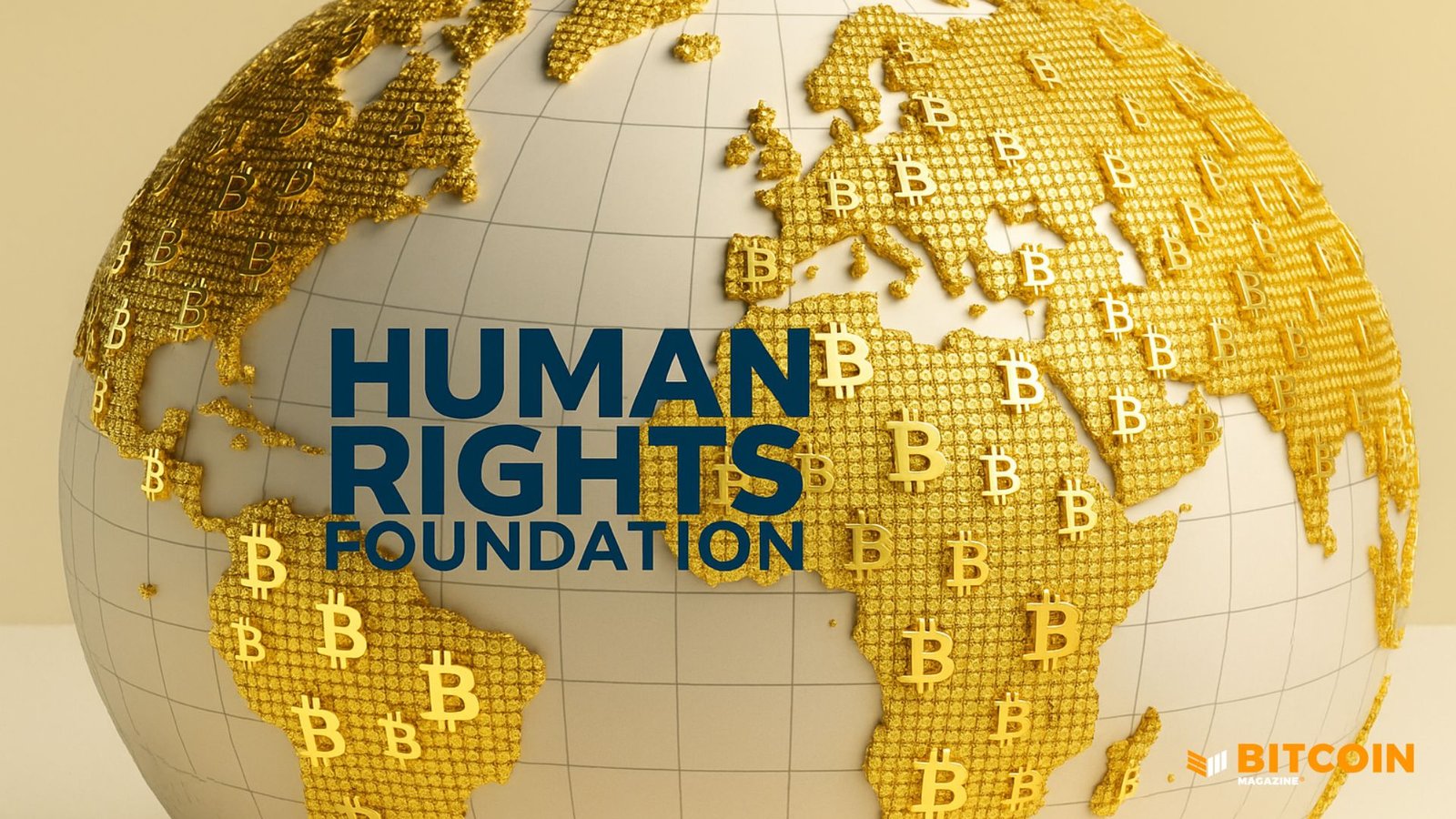

The Human Rights Foundation (HRF) has announced 1.3 billion satoshis in new grants from its Bitcoin Development Fund, backing 22 projects worldwide aimed at strengthening financial freedom and censorship resistance under authoritarian regimes.
The funding round, disclosed today exclusively to Bitcoin Magazine, will support open-source Bitcoin development, decentralized mining infrastructure, privacy-preserving financial tools, and grassroots education initiatives across Asia, Africa, and Latin America.
HRF said the projects are designed to improve the Bitcoin protocol itself while expanding access to permissionless money for dissidents, journalists, nonprofits, and ordinary citizens facing political repression.
The full list of recipients is as follows for the fourth quarter of 2025.
Bitcoin Decentralization
Stratum V2 (Stratum Reference Implementation)
Much of Bitcoin mining still relies on outdated communications protocols that prevent individual miners from choosing the transactions they mine. This leaves block construction in the hands of mining pools, exposing the network to censorship risks. Stratum V2 solves this fault by enabling home miners to build their own block templates. HRF funding will support software developer bit-aloo’s full-time work improving Stratum V2 through performance testing, integration work, and code maintenance, helping individuals regain autonomy within existing pool structures.
Braidpool
Traditional Bitcoin mining pools rely on a centralized structure where the operator controls reward payouts and transaction selection, creating censorship risks. Braidpool addresses this structural centralization by introducing a peer-to-peer, open-source mining pool design where participants collaboratively construct blocks and coordinate rewards without relying on a central operator. With HRF support, software developer Mohd Zaid will advance a new, more democratic mining model that strengthens decentralization and transparency.
Bitcoin Education
Open Money, Closed Access: Building Financial Freedom (OMCA)
In conflict-affected and connectivity-constrained environments, communities are often cut off from formal banking services and safe ways to store or transfer value. OMCA addresses these challenges through Bitcoin-based tools designed for low-cost, private transactions and offline-first use. The program supports the development of local financial infrastructure and resilient communications technologies suited to high-risk contexts. HRF’s support enables individuals to save and transact more securely and discreetly during periods of instability.
Learning Bitcoin from the Command Line
As Bitcoin evolves, open-source developers need up-to-date resources that teach them how the system actually works. Learning Bitcoin from the Command Line teaches prospective developers how Bitcoin works through a hands-on curriculum and across multiple languages. HRF’s funding will allow the project to update its curriculum to match the latest changes to Bitcoin’s software, helping grow the global pool of contributors who keep Bitcoin accessible and resilient.
Voices Uncensored: A Bitcoin-Based Platform for Human Rights Defenders in Azerbaijan
In Azerbaijan, the state routinely targets activists and journalists with surveillance, bank freezes, and blocked donations. Voices Uncensored is a Bitcoin-based platform for human rights defenders led by former political prisoner Elchin Mammad. It pairs uncensorable donations and payments with Azerbaijani-language training and educational resources. HRF’s support will equip Azerbaijan’s human rights defenders with the financial independence, privacy, and resilience needed to continue their work under a repressive regime.
Bitcoin Famba
In Mozambique, citizens face chronic inflation, growing debt, and heavy restrictions on their financial autonomy. Bitcoin Famba, based in Maputo-Matola, provides accessible Bitcoin education and fosters local circular economies. HRF funding will help dissidents and everyday people access permissionless and censorship-resistant money to achieve financial independence in a repressive political and economic environment.
Bitcoin Indonesia & Bitcoin House Bali
Indonesians face growing financial surveillance, inflation, and censorship. Bitcoin Indonesia, Indonesia’s pioneering Bitcoin gathering, along with its Bitcoin education center, Bitcoin House Bali, offers training on using Bitcoin to protect incomes, preserve financial autonomy, and navigate restrictive banking systems. HRF’s funding will expand its workshops, meetups, and media outreach to make Bitcoin a practical tool for financial freedom across the country.
The Bitcoin Learning Center
Across Southeast Asia, millions of people face financial surveillance, exclusion from traditional banking systems, and currency instability. The Bitcoin Learning Center, a physical Bitcoin education hub in Chiang Mai, Thailand, brings students from Thailand, Burma, Laos, and Southern China to learn how to counter this financial repression through Bitcoin. HRF support will expand the center’s educational outreach to ensure more people living under authoritarian regimes gain access to open and decentralized financial tools.
Bitcoin Development
Devgitotox
Bitcoin’s reliability and security depend on a robust codebase. Devgitotox is a Tanzanian Bitcoin Core developer contributing to Bitcoin’s primary software implementation. Her work focuses on improving wallet upgrades, fixing issues with how transactions are created and shared, ensuring nodes connect reliably to the network, and building software testing tools. HRF’s support of Devgitotox helps strengthen the Bitcoin codebase while empowering more women to contribute to Bitcoin Core.
Stratospher
Bitcoin’s peer-to-peer network can be vulnerable to surveillance and disruption if weaknesses in transaction relay, validation logic, or cryptographic components are not addressed. Stratospher, a Bitcoin Core developer from South Asia, strengthens the protocol by improving how nodes (computers running the Bitcoin software) share and spread information, improving validation and cryptographic systems, and enhancing code quality through reviews and testing. With HRF funding, her contributions will help ensure that Bitcoin remains a robust tool for financial freedom.
Sovereign Engineering
Authoritarian regimes actively suppress financial freedom, leaving human rights defenders in need of open and censorship-resistant financial technologies. Sovereign Engineering is a long-term development program that supports freedom technologists building on Bitcoin, Nostr, and ecash. Already, the program has catalyzed projects like Blossom, which stores data on public servers in a decentralized manner, and npub.cash, a Nostr-native Lightning address for anyone. With this funding, the program will continue to innovate on freedom technologies that protect civil liberties under repression.
OpenSats Initiative, Inc.
Open and transparent funding is key to sustaining many of the freedom technologies human rights defenders rely on today. OpenSats is a public nonprofit organization that supports the projects and the individuals building freedom tech by distributing financial support across the ecosystem. With this grant, OpenSats can fortify its operations and continue channeling resources to the builders who keep freedom tech open, secure, and accessible for people living under tyranny.
Lightning Development
Africa Free Routing Lightning Developer Bootcamp
Bitcoin adoption is rising across Africa, but access to quality education and development training is often limited or unaffordable. Africa Free Routing’s Lightning Developer Bootcamps address these mismatches by providing structured programs that combine theory, hands-on workshops, and mentorship to software developers. These same developers can then contribute to the Lightning Network and build censorship-resistant financial tools. With HRF funding, the program will expand to ten bootcamps across Ethiopia, Uganda, Burkina Faso, and beyond to foster a continent-wide network of freedom tech contributors.
Programming Lightning
In many repressive environments, the Lightning Network ecosystem suffers from a shortage of skilled developers, leaving censorship-resistant payment tools underbuilt and unevenly maintained where they are needed most. Programming Lightning is an open-source course that will offer self-paced, multi-language learning with hands-on programming exercises. The curriculum will teach anyone to build on Lightning. This grant will help scale a global community of builders to sustain an open payment infrastructure that activists can use to sustain their work under repression.
Freedom Tech
Zapstore
Authoritarian regimes can censor freedom-tech apps on centralized app stores to control information and limit tools for communication and organizing. Zapstore is an app store built on Nostr, a protocol for decentralized communication. On Zapstore, apps can be independently uploaded and verified by users, without being blocked or removed by dictators. HRF’s support will ensure that dissidents, journalists, and civil society around the world have access to freedom tech without gatekeepers.
Validating Lightning Signer
Most computers running the Lightning Network software today store private keys on the node itself. This creates an online setup where a breach can allow attackers to drain a user’s bitcoin. Validating Lightning Signer (VLS) solves this by separating key management from the node and validating every transaction before signing, enabling true self-custody and resistance to breaches. With HRF support, VLS will lower the barrier for people to safely control and use their own money on the Lightning Network, even in places where financial and digital rights are under threat.
Vexl
Dissidents acquiring bitcoin often need to do so privately to protect their identity, donor networks, and personal safety. Yet centralized exchanges often collect vast troves of personal information and monitor user activity. To address this, Vexl, an open-source mobile app, allows peer-to-peer bitcoin trading without collecting personal data. With HRF’s support, Vexl can provide human rights defenders and civil society in authoritarian contexts a means to acquire Bitcoin without surveillance and absent gatekeepers.
Dhananjay Purohit
Dictators frequently restrict the finances of online platforms and independent media to silence dissent. To overcome this, open source developer Dhananjay Purohit built ngx_l402, a web server module that enables websites and applications to accept bitcoin payments directly for web or API access. With HRF’s grant, Purohit’s work can help embed bitcoin payments into the internet infrastructure layer, keeping the web open, uncensorable, and resistant to centralized financial control.
BTCPay Server
Under dictatorships, traditional nonprofit fundraising channels can be censored, surveilled, frozen, or cut off without warning. BTCPay Server uses the permissionless foundations of Bitcoin to work around this. Using this open-source and self-hosted software, NGOs and dissidents can freely accept Bitcoin and Lightning payments directly into their self-custodial wallets. HRF’s renewed support will ensure censorship-resistant crowdfunding in even the most repressive environments.
Bitika
In Kenya, obtaining bitcoin can be challenging. Bitika addresses this by allowing users to buy bitcoin directly into their Lightning wallets through M-Pesa (the country’s most widely used financial infrastructure). This makes self-custodial Bitcoin use simple and accessible. This grant will help Bitika improve Kenyans’ financial independence by expanding access to censorship-resistant money in an increasingly surveilled payments landscape.
Threads of Freedom: A Bitcoin Graphic Novel and Learning App
Young people, especially women and girls, who live under repressive regimes often lack access to financial education. Threads of Freedom, created by Afghan tech pioneer and founder of the Digital Citizen Fund, Roya Mahboob, provides a culturally-rooted graphic novel and learning app that explains how Bitcoin works and why it matters under tyranny. With HRF support, Threads of Freedom will expand access to education that helps people protect themselves and remain financially autonomous under repression.
