


In brief
- China’s Z.AI released a major open-source image model that was trained entirely on Huawei chips.
- It uses a hybrid autoregressive-diffusion design that boosts text accuracy and spatial control.
- The release signals China’s push toward AI self-reliance without U.S. GPUs.
Chinese artificial intelligence firm Z.AI on Wednesday released an open-source image generation model trained entirely on Huawei processors, marking the first time a major AI model has completed its full training cycle without relying on American hardware.
The move highlights a potential long-term challenge to Nvidia’s dominance in AI chips, since it shows that one of China’s top AI companies can train large models without relying on U.S.-made GPUs.
The model is already available for download on Hugging Face and produces good—yet not impressive by today’s standards—results in terms of aesthetics and coherent text, and shows excellent spatial awareness based on our first quick tests.
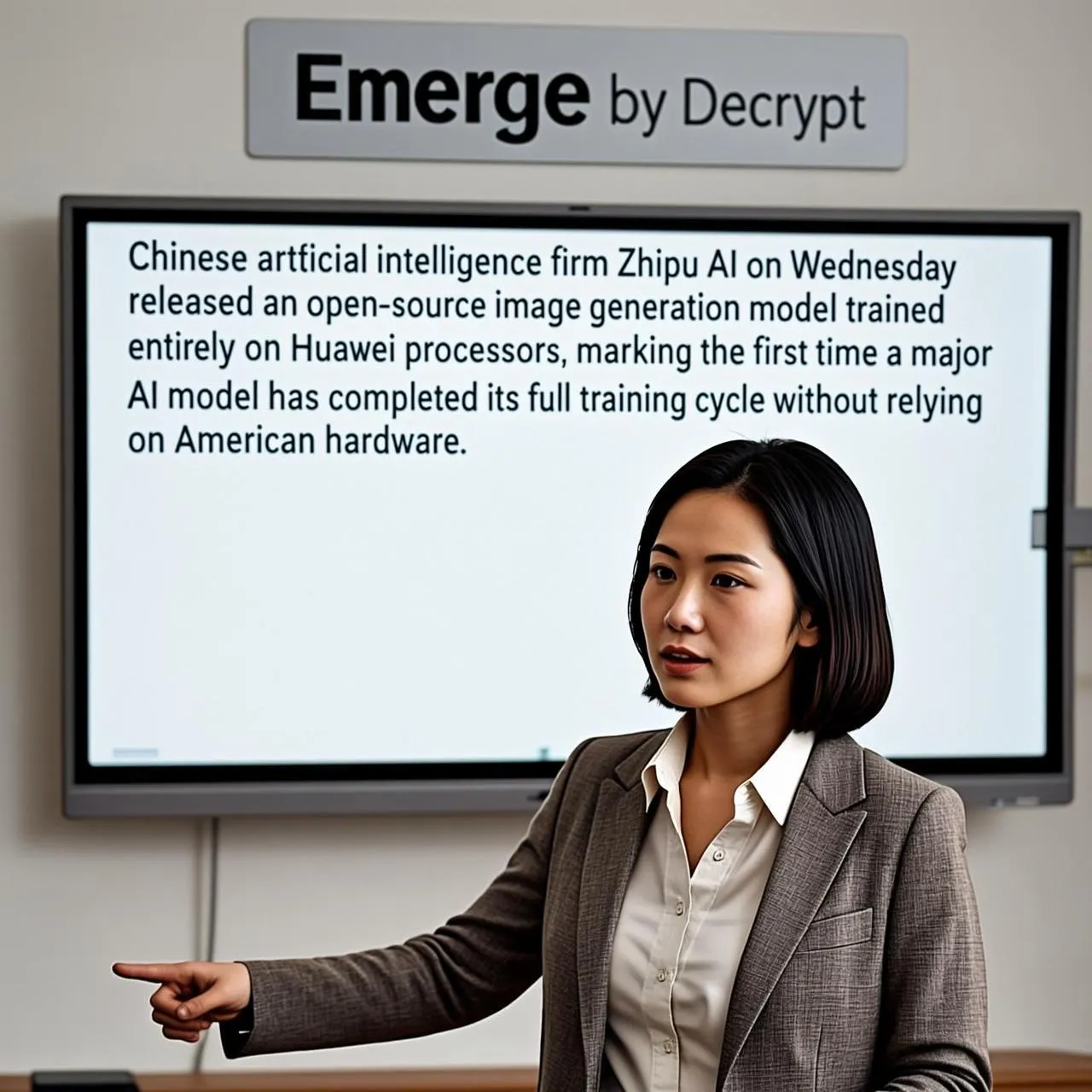
The Beijing-based company, which raised $558 million in its Hong Kong IPO last week, trained the model, called GLM-Image, on Huawei’s Ascend Atlas 800T A2 servers using the MindSpore framework.
“We hope this can provide valuable reference for the community to explore the potential of domestic computing power,” Z.AI said in a statement shared with the South China Morning Post.
Introducing GLM-Image: A new milestone in open-source image generation.
GLM-Image uses a hybrid auto-regressive plus diffusion architecture, combining strong global semantic understanding with high fidelity visual detail. It matches mainstream diffusion models in overall quality… pic.twitter.com/cjtUYRkge5
— Z.ai (@Zai_org) January 14, 2026
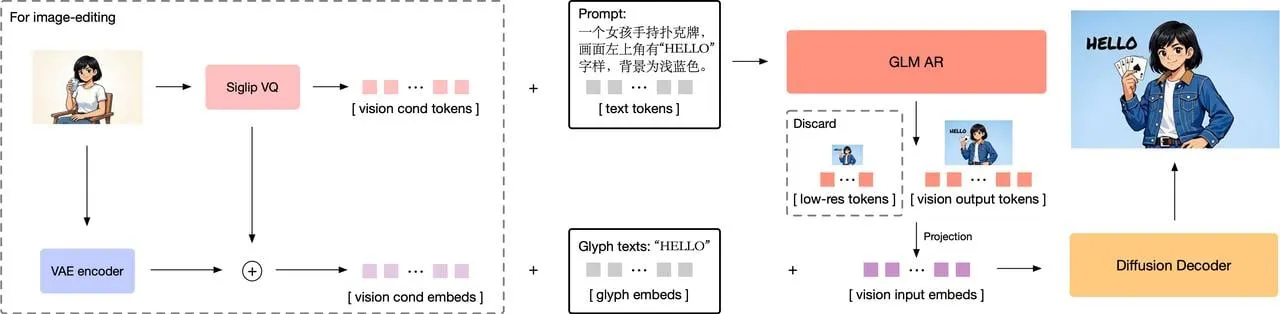
GLM-Image combines autoregressive and diffusion techniques in a hybrid architecture with 16 billion total parameters. The autoregressive component, based on Z.AI’s GLM-4 language model, handles instruction understanding and image composition, while a diffusion decoder refines fine details. This approach mirrors techniques used by OpenAI’s latest image generation model gpt-image-1.5, which has demonstrated superior text rendering and prompt adherence compared to pure diffusion models like Stable Diffusion.
Diffusion models make images by starting with random visual noise and slowly refining it into a picture, while autoregressive models build images step by step, predicting each part based on what came before. Diffusion is great at overall realism but can struggle with precise details like text or layout, whereas autoregressive models excel at structure and instruction-following. Right now, diffusion is the king technique among open-source AI image generators.
New hybrid systems combine both approaches, using autoregressive generation to plan the image and diffusion to polish the final result.
The release carries weight for Z.AI, which Washington blacklisted in 2025 over alleged ties to China’s military. That designation cut the company off from Nvidia’s H100 and A100 processors. Now, Z.AI has proven that blacklisted firms can still produce competitive AI systems using domestic hardware, a development Beijing has long sought to demonstrate.
Just after Z.AI’s announcement, Reuters reported that Chinese customs authorities had instructed agents to block Nvidia H200 chips from entering the country. Government officials summoned technology companies to meetings where they were told not to purchase the chips unless necessary. The wording, according to sources, was severe enough to constitute “basically a ban for now.”
Beijing appears to be signaling that Chinese AI labs can build capable models without American silicon, reducing the urgency for Chinese firms to stockpile Nvidia hardware. The H200, which delivers roughly six times the performance of the H20 chip that Beijing already blocked last August, had generated orders from Chinese companies for more than two million units at $27,000 each.
Analysts at Georgetown’s Center for Security and Emerging Technologies have noted that China’s chip strategy relies on compensating for lower per-chip performance with massive clusters of Huawei processors. The approach works, but requires more hardware, more power, and more engineering effort.
“One of the key constraints in this strategy is China’s capacity to produce enough chips domestically to make up and keep up with the gap in capability,” senior research analyst Hanna Dohmen told CNBC in November.
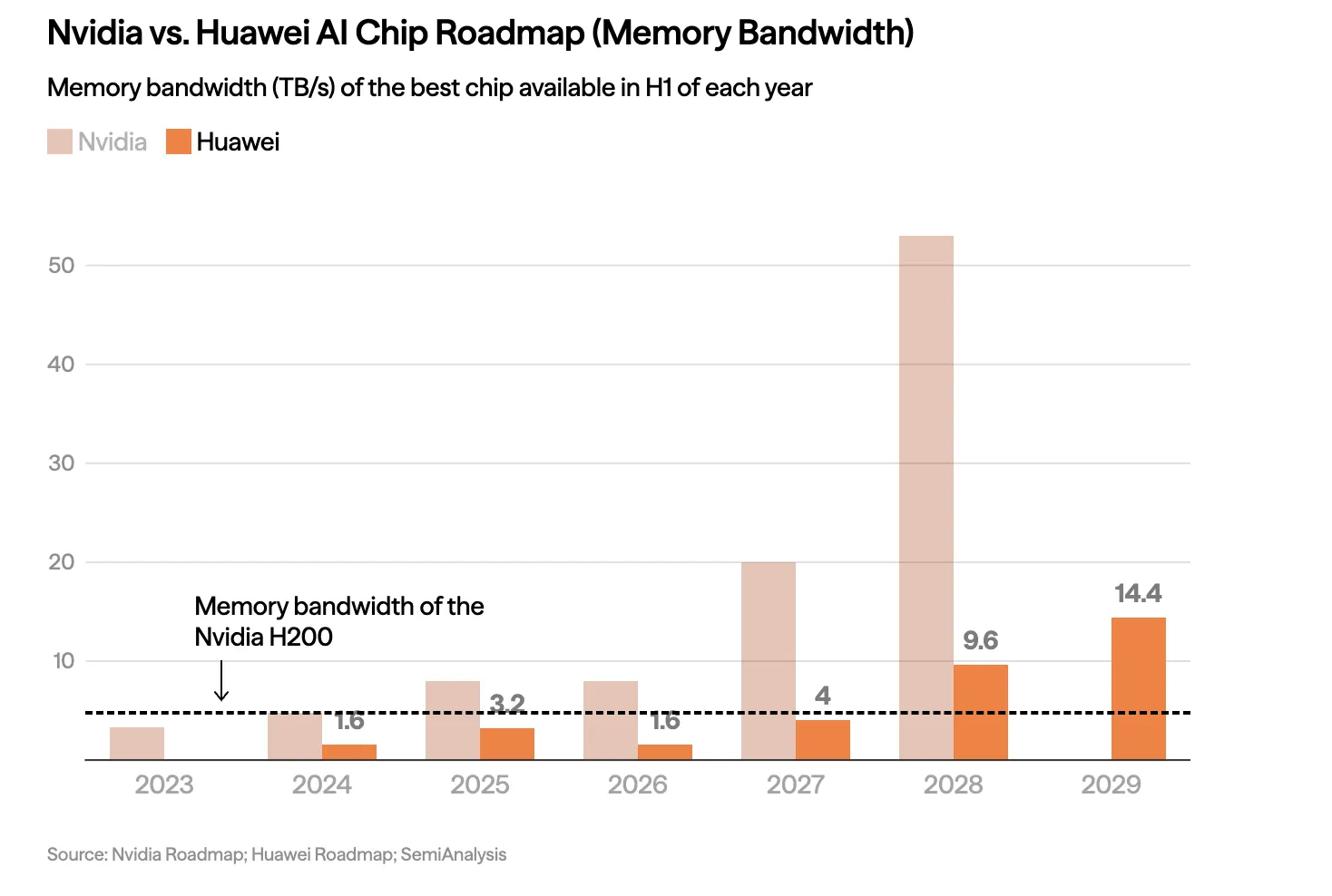
According to Huawei’s own roadmap, its next-generation chip in 2026 will actually be worse than its current flagship in terms of raw power. But such assessments may underestimate what Chinese labs can achieve through algorithmic efficiency, as DeepSeek demonstrated by training competitive models with fewer chips through assembly-level GPU optimization.
Z.AI’s GLM-Image achieved industry-leading benchmark scores among open-source models for text rendering and Chinese character generation, according to the company’s technical report. Those without the proper hardware may also try it online with API access priced at $0.014 per generated image, or via a free Hugging Face Space maintained by Z.AI.
Z.AI became the first of China’s “AI tigers,” a group of startups building large language models to rival OpenAI and Anthropic, to go public. Its stock has climbed around 80% since listing, following investor enthusiasm for Chinese AI firms like DeepSeek or Alibaba amid China’s domestic chip ambitions.
Huawei, meanwhile, is preparing to sharply increase production of its Ascend processors this year. The company’s booth presence at AI conferences across China has grown more prominent as it tries to position itself as the backbone of a national AI infrastructure that no longer depends on Santa Clara.
Daily Debrief Newsletter
Start every day with the top news stories right now, plus original features, a podcast, videos and more.
