
In 2026, businesses that leverage AI solutions are seeing measurable gains in productivity and efficiency. In fact, 51% of enterprise AI teams today are using RAG architectures, and they are seeing improved answer accuracy reaching 94% compared to 67% for traditional LLMs
One of the most powerful innovations driving this change is Retrieval-Augmented Generation (RAG), a technology that combines data retrieval with generative AI so enterprises get accurate, context-rich answers from their own knowledge sources rather than generic outputs. RAG platforms help businesses reduce time spent searching for information, improve decision-making, enhance customer support, and cut operational costs.
If your organization isn’t exploring RAG yet, you risk falling behind competitors who are already using it to automate workstreams, increase accuracy, and unlock strategic insights. This blog will guide you step-by-step on how to build an RAG platform in 2026.
Key Takeaways:
- RAG platforms assist enterprises in converting fragmented enterprise data into context-responsive AI responses.
- A solid RAG stack integrates clean data, dependable retrieval, and well-constructed prompts.
- Enterprise integration cannot do without security, access control, and performance testing.
What does RAG mean?
RAG is an abbreviation of Retrieval-Augmented Generation. Simply put, it is an AI method in which a model will initially locate correct information in your data (documents, databases, PDFs, tools) and then create a response based on that contextualization—rather than guessing.
The global RAG market was ~USD 1.94–1.96 billion in 2025 and is projected to grow to ~USD 9.86 billion by 2030 with ~38–39% CAGR. For businesses, this means:
The answers provided by AI are grounded in your own knowledge and not generic information available on the internet.
- Reduced hallucinations, more correct answers.
- Reports, SOPs, policies,
- Customer data is accessed faster.
Why Businesses Need RAG Platforms in 2026?
In 2026, companies will be creating enormous amounts of internal data, and unless they have systems that are smart on access, teams will also not be able to derive value, make decisions, and scale effectively in an AI-based competitive world.
- Detonation of Intermediate Information: The information in businesses is stored as PDFs, CRM, ERP, email, and tools. RAG platforms consolidate this information so that it can be accessed on the spot and accurately, so that it does not require time searching manually.
- Growing Demand for Context-Sensitive AI Responses: Generic AI applications provide superficial answers. RAG platforms provide the solution based on company-specific information that is relevant, accurate, and trustworthy to the decision-makers.
- Cost and Productivity: Manual workflows are not affordable to teams as the costs increase. RAG automates back-office repetitive queries, lessens the reliance on human support, and liberates the teams to work on activities with higher value.

Step-by-Step: How To Build a RAG Platform in 2026?

In 2026, RAG platform development and its applications will have to be an organized, business-centered process that targets actual workflows, trusted data, and quantifiable results, rather than an experiment with no direction and defined ROI.
Step 1- Recognize High-Impact Business Use Case
Begin with repetitive, knowledge-intensive tasks that are wasting time every day for the team. Consider the use cases, such as support queries, internal documentation search, compliance checks, or sales enablement, where a faster, correct answer directly leads to a positive productivity outcome and low cost of operation.
Step 2 – Prepare and Clean Business Data
The quality of data is relied on in RAG performance. Gather documentation, eliminate duplicates, fix obsolete documents, and harmonize formats. Quality and clean data would guarantee data retrieval accuracy, minimize hallucinations, and create trust in AI output among business teams.
Step 3 – Choose RAG Stack and Infrastructure
Select the appropriate balance of LLMs, vector databases, and hosting according to security, scale, and budget. Choose between on-prem or cloud-based systems, open-source or proprietary, and those that are compatible with the current business applications.
Step 4 – Develop Retrieval and Context Logic
Pre-generation design the queries to retrieve the most relevant information. These are chunking strategy, similarity search, ranking, and prompt design. Powerful retrieval logic keeps the response grounded to business data and keeps the response accurate to the context.
Step 5 – Accuracy, Latency, and Security Testing
Test system with real business queries. Test the relevance of answers, response time, and data leakage hazards. Frequent testing aids in fine-tuning the quality of retrieval, load testing, and upholding internal security guidelines.
Step 6 – Deploy, Monitor, and Optimize
Implement the platform step by step, observe the patterns of use, and receive feedback. Keep the data up to date, perfect prompts, and enhance retrieval logic. Continuous optimisation will make sure that the RAG platform will grow as the business grows and create long-term value.
Real-World Business Use Cases of RAG Platforms
RAG platforms assist the business in transforming disconnected documents and data into trusted, AI-driven solutions that allow the staff to work more quickly, make superior decisions, and minimize the reliance on manual searches and redundant work.
- Customer Support Knowledge Assistants: The RAG instantly corrects answers based on FAQs, manuals, and past tickets, allowing support teams to address problems more quickly and spend less time handling similar questions across different customer touchpoints.
- Auto-Quoting and Sales Proposal: RAG helps Sales teams save hours and create accurate and on-brand documents by auto-generating proposals, pitch decks, and responses using approved case studies, pricing, and product data.
- Internal Operations/SOP Assistants: The RAG-powered assistants allow employees to find SOPs, HR policies, and process documentation quickly, thereby minimizing onboarding time and avoiding duplication of questions across operations and internal support.
- Search of Legal, Compliance, and Policy: RAG platforms enable legal and compliance departments to find contracts, policies, and regulations by searching them in an informal manner, reducing the risk of contracting illnesses based on the fact that all responses are always based on approved and updated documents.
- Supply Chain & Logistics Intelligence: RAG systems for decision making use a combination of TMS, ERP, and reports to provide real-time information on inventory, delays, and performance, and assist the teams to react more promptly to disruptions and bottlenecks in operations.
Future of RAG Platforms Beyond 2026
RAGs are no longer just about providing a question-answer system but are becoming intelligent, networked platforms that provide businesses with active support in decision-making, automation of business processes, and provision of real-time and context-sensitive data in a variety of data formats.
- RAG + AI Agents of Autonomous Workflows: The use of Agentic RAG will further automate the entire end-to-end operations performance, enabling systems to retrieve data, act, update tools, and automate repetitive business activities with minimal human intervention.
- Multimodal RAG (Text, Voice, Images, Video): Multimodal RAG will allow platforms to read, hear, see, and find information in text, audio records, pictures, and videos, and will make knowledge within an enterprise easier and accessible to use by teams.
- Real-Time RAG to make a decision: Real-time RAG will bridge the real-time data sources to AI models, providing leaders with instant, context-relevant insights that enable them to make faster and more precise operational and strategic decisions.

Conclusion
RAG application development in 2026 is not about following the AI trends but rather addressing the actual business issues and providing reliable and context-aware intelligence. RAG can transform disorganized documents and data into one source of truth that can be relied upon by your teams when properly done.
With clean data, an emphasis on clear use cases, the appropriate technology stack, and constant optimization, businesses will save hours of manual work, minimize errors, and make faster decisions. With the faster adoption of AI, businesses investing in properly designed RAG systems today will benefit by having a sustainable operational and competitive edge tomorrow.
SoluLab, an RAG app development company, can help you build RAG platforms from scratch. Book a free discovery call today!
FAQs
Chatbot works according to a set of pre-defined flows, whereas a RAG platform recalls real-time business information and formulates exact and context-specific answers.
RAG saves time on document search, eradicates knowledge silos, enhances the decision-making process, and automates repetitive information-driven work across the teams.
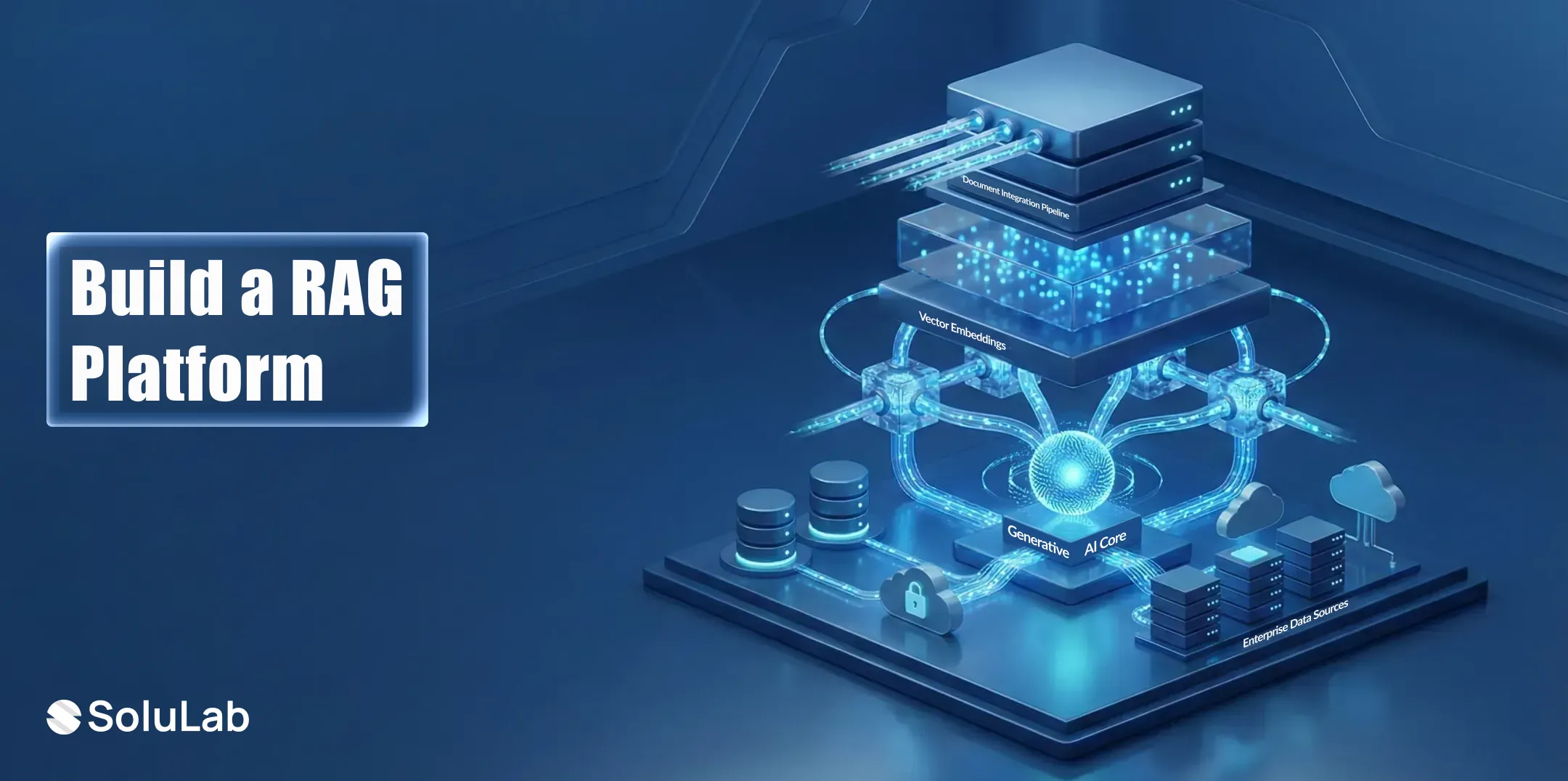
The main components of a standard RAG stack are an LLM, a database of vectors, an embedding model, retrieval logic, pipelines of data, and secure infrastructure.
Yes, when designed correctly with access controls, encryption, private deployments, and compliance policies to protect sensitive business information.
Depending on the use cases and readiness of data, a functional RAG MVP may be developed within 4-6 weeks, and a secure, production-ready platform may be developed within 8-12 weeks.
