

An AI proof of concept (POC) is commonly the initial tangible action that businesses undertake on the path to using artificial intelligence. Yet a lot of AI POCs do not succeed, not due to the weakness of the technology, but because the purposes, data, or implementations are not clear.
Studies find that up to 88% of AI proofs of concept fail to reach operational deployment, often due to unclear goals, poor data readiness, or lack of production planning.
An effective AI POC is not a form of development of a perfect model; it is a form of checking whether AI can attain a realistic solution to a particular business issue. Properly applied, an AI POC can assist teams to mitigate risk, coordinate stakeholders, and make decisions before committing resources to a full-scale AI development.
This step-by-step guide simplifies the whole process step by step, as it defines data preparation and performance testing, and business impact measurements.
Key Takeaways
- An AI POC begins with a defined business problem rather than a technical concept.
- Data quality is even more important than the complexity of the models.
- Make POC small, rapid, and quantifiable.
- Engaging business, technical, and data teams at an early stage will deliver operational alignment of the AI POC.
- A powerful AI POC must be simple to refine, extend, and transfer to production after validating it.
What is an AI POC?
An AI POC (Proof of Concept) is a small, practical project built to test whether an AI idea actually works in the real world. For example, A government tests an AI model to predict traffic congestion in one city area before rolling it out city-wide.
Why companies build an AI POC:
- To validate an idea before investing big money
- To test data quality and model performance
- To reduce risk before full-scale development
Key Business Benefits Of Building An AI POC
Creating an AI Proof of Concept (PoC) assists businesses in experimenting with AI concepts, simulating value with actual information, and making wiser investment choices prior to dedicating to an extensive deployment.
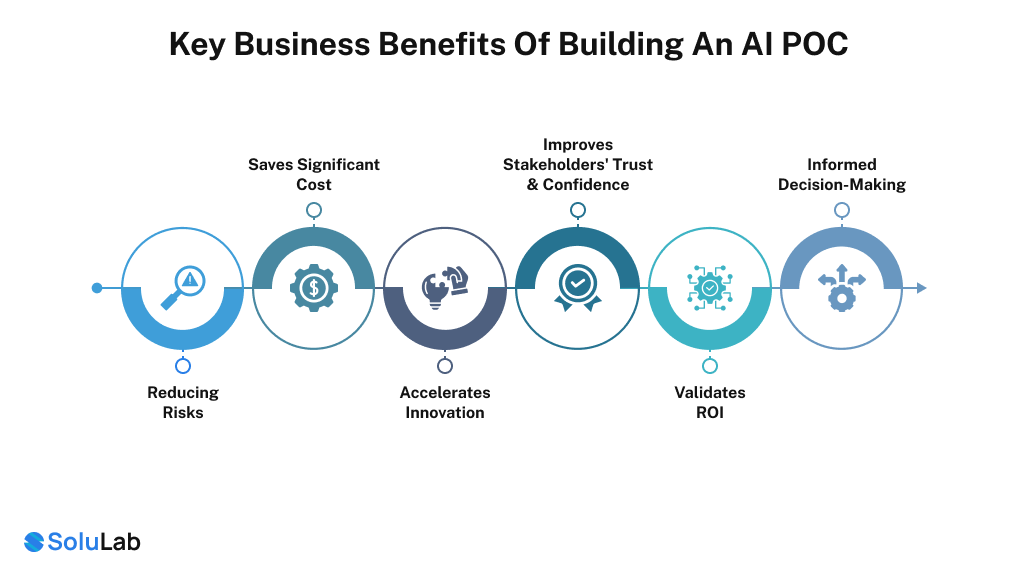
1. Faster decision-making: An AI PoC provides a stakeholder with early and data-driven insights rather than assumptions. The teams can test a model on real scenarios and thus can assess feasibility, performance, and business impact within a short period of time; therefore, they can make decisions to go/no-go faster.
2. Risk reduction: The PoCs decrease uncertainty through the early detection of technical, data, and operational issues. This helps to avoid expensive errors in deployment on a large scale and makes sure AI solutions are not created before a large-scale investment is made.
3. Cost efficiency: An AI PoC enables small companies to develop ideas with minimal investments instead of spending a lot on upfront investments. It can be used to prioritize the high-impact use cases and prevent investing in AI projects that would not add value.
4. Operational insights: AI PoCs display the patterns of existing data, inefficiencies, and opportunities. These insights contribute to the team being more familiar with workflows, streamlining processes, and knowing in which areas artificial intelligence can particularly produce the most significant impact in operation.
5. Strategic alignment: An effective PoC makes AI projects serve as business enablers. It also allows the leadership to respond to technological activities to their long-term strategy, which will see AI adoption produce quantifiable results, as opposed to experimental work.
Step-by-Step Guide on How to Build an AI POC
Creating an AI proof of concept assists organizations in testing ideas fast, lowering risk, and justifying actual business worthiness prior to dedicating time, capital, and assets to full-scale AI execution.
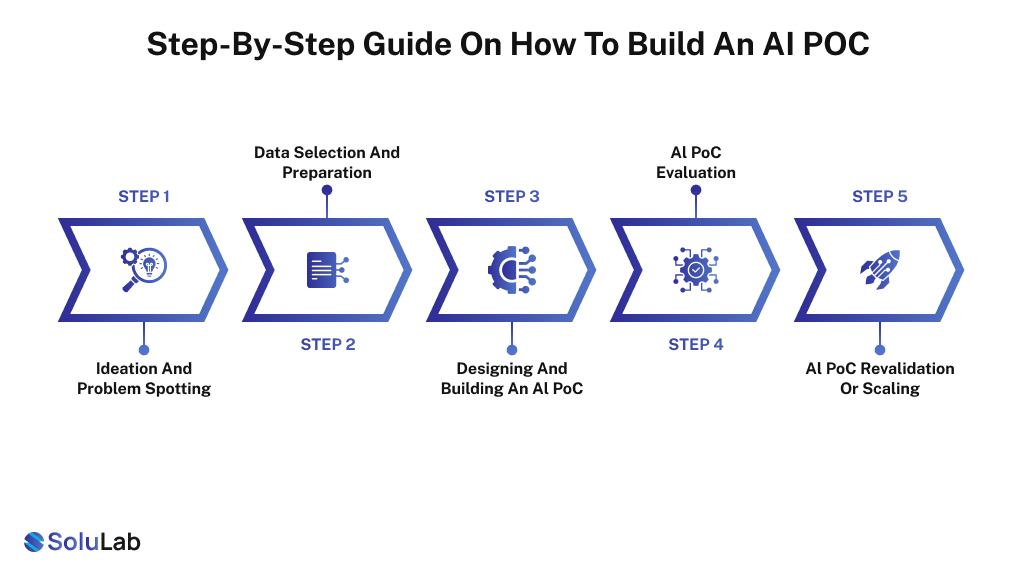
Step 1: Problem Identification
Specify the business problem about which you want AI to provide solutions. Target a narrow, impactful application as opposed to a general concept. Focus the problem on business objectives such that the POC can show pragmatic value and not technical feasibility.
Step 2: Establish Quantifiable Metrics
Establish the measurement of success before development begins. Measures might be accuracy, cost saved, time saved, or better quality of decision. Clear KPIs allow the stakeholders to objectively assess the AI POC in terms of meaningful results.
Step 3: Assess the Preparedness of Your Data
Determine the availability, accuracy, completeness, and relevance of your data. Detect loopholes, inconsistencies, or prejudices. The quality of data has a direct impact on the model performance. This step will make sure that the POC is constructed based on reliable inputs.
Step 4: Choose the appropriate AI Technique
Select an AI methodology that is suitable for the data type and problem, e.g., machine learning, natural language processing, or computer vision. Make a POC solution simple, and focus on usable explanation and speed instead of sophisticated architectures.
Step 5: Build and Train an AI Model
Create a simple model based on a small set of data to confirm that it works. Optimize the model by training it repeatedly. It is not aimed at perfection, but to prove that AI can be effective in solving the specified issue.
Step 6: Testing and Validation
Use unseen data to test the accuracy, reliability, and consistency of the model. Compare findings with set standards. The step is useful in determining constraints, edge cases, and risks before pursuing further development or expansion.
Step 7: Documentation
Assume documents, sources of data, model options, outputs, and learnings. Proper documentation would result in transparency, the ability of stakeholders to interpret the results, and would give a solid basis to develop the POC into a production-ready AI solution.
Future Trends in AI POC Development
The development of AI applications is changing rapidly, as is the case with the POCs of the future:
1. Reduced POC to Production Cycles: Production is being considered at the beginning of the design of AI POCs by organizations. Teams no longer undertake isolated experiments; instead, reusable architectures, cloud platforms, and models packed with pre-trained models are used to reduce the time spent on validation and deploy successful POCs into production environments fast.
2. Use of Generative AI in POCs: Generative AI is taking center stage in AI POCs, particularly in chatbots, content automation, and decision support systems. Fine-tuning Foundation models are used to test use cases in business first, then refined with domain data to demonstrate value at a minimum initial investment.
3. It is More about Business Metrics, rather than Accuracy: The next generation AI POC will be evaluated based on business measures such as cost-saving, time savings, and an increase in revenue. The teams are matching POC success metrics to KPIs to have the stakeholders understand clearly how AI solutions for enterprises are addressing the objectives.
4. Low and No-Code AI Development: AI POC development is becoming more accessible due to the low-code and no-code platforms. Now, non-technical teams are able to develop and test simple AI workflows swiftly so that organizations are able to test ideas more rapidly and subsequently engage engineering teams to create more complex workflows.
5. Accountable and Elucidable AI by Default: AI POCs are already being designed to incorporate ethics, transparency, and compliance. Trying to explainability, bias detection, and data governance are done at the POC phase itself, mitigating risks, and making the process of approvals at the enterprise-wide level of AI usage more enjoyable.
Conclusion
The creation of a successful AI POC does not primarily revolve around displaying high-tech capabilities, but rather resolving an actual business issue. When experiments with AI begin with specific goals, appropriate data, and quantifiable measures of success, AI experiments become meaningful results.
A properly designed POC assists in validating feasibility, risk reduction, and is early aligned with the stakeholders. With scalability, feedback, and constant improvement, businesses are assured that they will go from their concept to production.
SoluLab, a trusted AI development company, can help you plan, build, and validate a successful AI POC. Book a free AI consulting call today!
FAQs
AI POC passes technical feasibility, prototypes demonstrate design, pilots that test early users, and MVPs that are ready to market are built.
ROI can be calculated on the basis of such clear results as time saved, cost decrease, accuracy enhancement, or process efficiency compared to the current workflows.
It usually requires 4 weeks to complete most AI POCs, depending on the availability of data, the complexity, and the clear business objectives.
AI POC is not a uniform type of expenditure; prices start at several thousand and go up to tens of thousands of dollars, depending on scale, instruments, and the competence of the team.
