

Key Takeaways
- The problem: AI is everywhere, but most teams mix up AI agents and agentic AI. This confusion leads to wrong implementations, overhyped expectations, and systems that either underperform or become too complex to manage.
- The solution: AI agents handle specific tasks with control and predictability, while agentic AI focuses on achieving broader goals with autonomy and adaptability. The real value comes from knowing when to use each and how they can work together.
- How SoluLab helps: SoluLab designs AI systems with the right balance of control and autonomy. As an AI-native company, we use AI in our workflows to deliver faster and at a lower cost while building scalable, secure, and production-ready solutions.
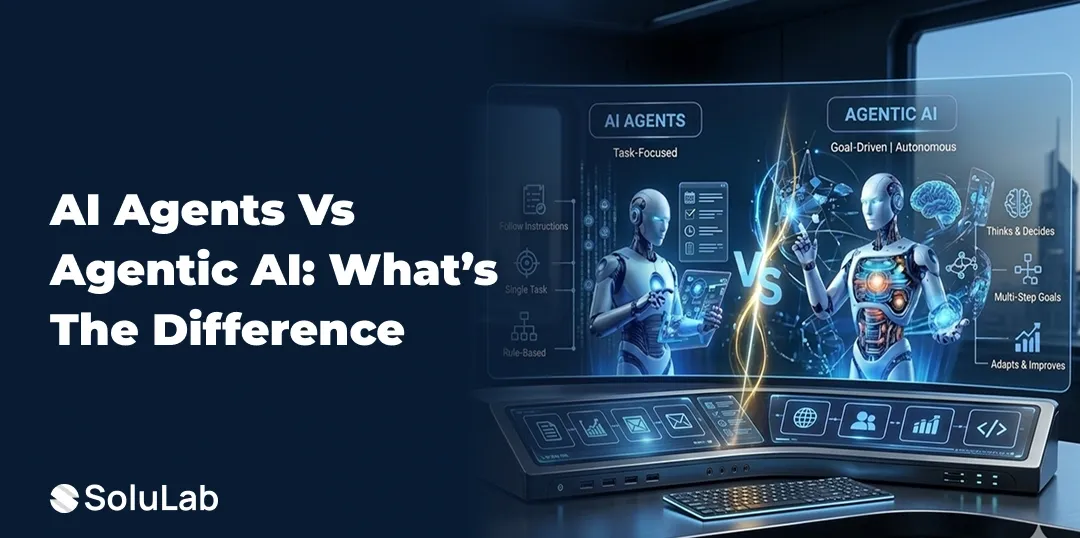
AI agents and agentic AI are often used interchangeably, but they’re not the same. Both aim to automate work, reduce manual effort, and improve decision-making, yet they operate at very different levels.
AI agents are built to handle specific tasks within a defined scope, making them reliable for structured workflows. Agentic AI, on the other hand, is designed to pursue broader goals, plan actions, and adapt in real time.
This shift moves AI development from being a tool you use to something that can act on your behalf. Understanding the difference is important because it directly impacts how you design systems, manage risk, and scale automation across your business.
What are AI agents?
An AI agent is designed to handle a specific task within a defined scope. It takes input, decides what to do next, and then performs an action to move the task forward.
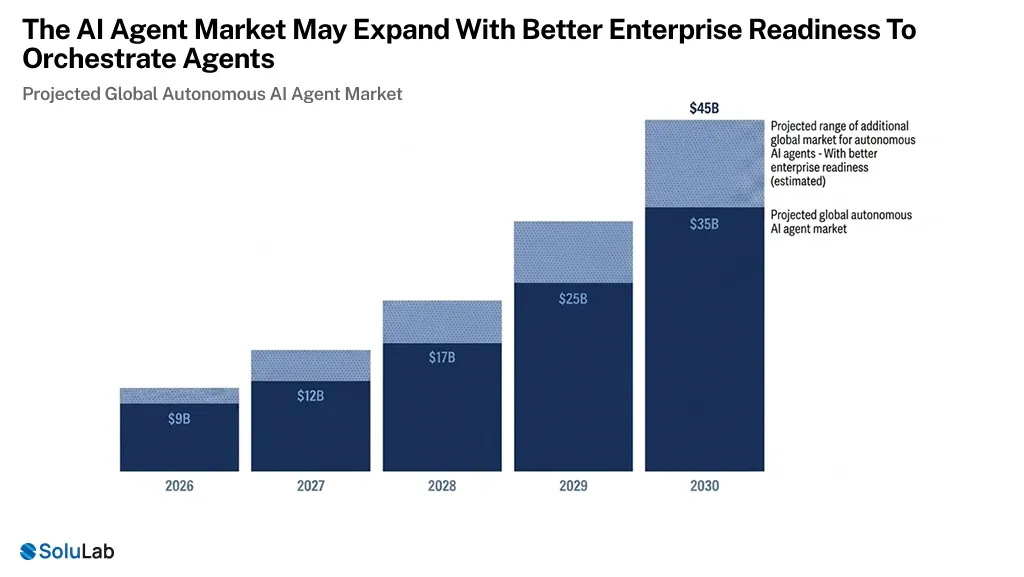
Large language models power many AI agents, but instead of chasing broad goals, they focus on completing short, well-defined tasks. According to Delloite, the Autonomous AI agent market is expected to reach $35B–$45B by 2030
Because of this focused design, AI agents work best for straightforward use cases. Examples include chatbots that answer FAQs, scheduling assistants that manage meetings, or tools that summarize documents. They function as small, task-oriented systems that combine reasoning, memory, and tools to complete one job at a time.
What is Agentic AI?
Agentic AI development refers to AI systems that can act independently to achieve goals, rather than just responding to prompts or performing single tasks. These systems can plan, make decisions, take actions, and adapt based on outcomes.
Agentic AI market projected to grow from ~$7B in 2025 to $93B+ by 2032. Agentic AI goes further. It:
- Understands a goal
- Breaks it into steps
- Executes tasks across systems
- Monitors results
- Adjusts its approach if needed
AI Agents vs. Agentic AI: a Quick Comparison
Here’s a complete comparison overview of AI agent nd Agentic AI.
| Aspect | AI Agents | Agentic AI |
| Core purpose | Built for specific, predefined tasks | Designed to achieve broader goals autonomously |
| Scope of work | Narrow and task-focused | Wide and multi-step, often cross-functional |
| Autonomy level | Limited autonomy within set rules | High autonomy with decision-making ability |
| Behavior | Executes instructions | Plans, reasons, and adapts dynamically |
| Workflow | Typically handles one task at a time | Orchestrates multiple tasks and systems |
| Adaptability | Works within predefined logic | Adjusts based on real-time data and outcomes |
| Examples | FAQ chatbot, meeting scheduler, document summarizer | End-to-end workflow automation, autonomous customer resolution, and research agents |
Now you know the basic difference between an AI agent and agentic AI. Here is an In-depth comparison between AI agents and agentic AI-
1. Task Execution Vs Goal Completion
AI agents are built to execute tasks. You give them a clear instruction, and they complete it within defined boundaries.
Agentic AI focuses on achieving outcomes. You give it an objective, and it figures out how to reach that goal, even if it requires multiple steps, iterations, or decisions along the way.
2. Level Of Autonomy
AI agents operate with limited autonomy. They can make small decisions, but usually within a controlled workflow.
Agentic AI operates with high autonomy. It can decide what actions to take, which tools to use, and how to adapt when things change.
3. Workflow Complexity
AI agents typically handle single-step or linear workflows. Even when multiple steps are involved, they are predefined and predictable.
Agentic AI manages multi-step workflows. It can orchestrate tasks across systems, handle dependencies, and adjust flows in real time.
4. Reasoning and Planning
AI agents have basic reasoning, often limited to selecting the next action in a sequence.
Agentic AI uses advanced reasoning and planning, including breaking down problems, prioritizing actions, and evaluating different approaches before acting.
5. Adaptability
AI agents are rule-bound. If the situation changes outside their scope, they fail or require human intervention.
Agentic AI is adaptive. It can respond to new data, unexpected outcomes, or changing goals by modifying its approach.
6. Memory and Context
AI agents usually rely on short-term context or session-based memory.
Agentic AI often incorporates longer-term memory, allowing it to learn from past actions, maintain context across workflows, and improve decision-making over time.
7. Risk and Control
AI agents are easier to control and audit because their scope is narrow.
Agentic AI introduces higher complexity and risk, since it operates with more freedom. This makes governance frameworks like AI TRiSM essential for monitoring, explainability, and safety.
How To Choose Between AI Agents And Agentic AI?
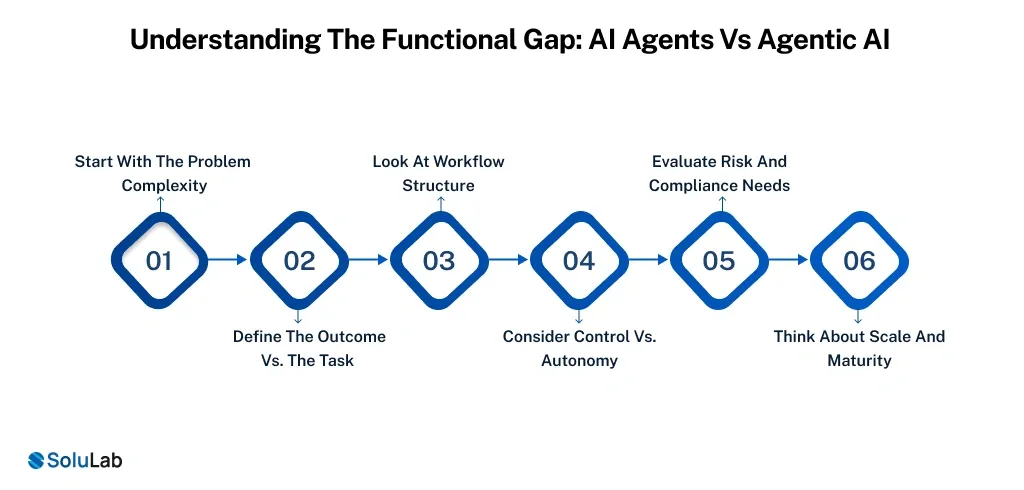
1. Start With The Problem Complexity
If your AI use case is clear, repetitive, and rule-based, go with AI agents. They work best when the task is predictable and doesn’t change much.
If the problem is open-ended, involves multiple steps, or requires decision-making, agentic AI is a better fit.
2. Define The Outcome Vs. The Task
Specify outcomes as per these questions:
- Do you want something to complete a task? Choose AI agents
- Do you want something to achieve an outcome? Choose agentic AI
This single distinction clears up most confusion.
3. Look at workflow structure
AI agents fit well in linear workflows like:
- answering queries
- generating reports
- scheduling tasks
Agentic AI is suited for workflows like:
- managing end-to-end operations
- optimizing processes continuously
- coordinating across multiple systems
4. Consider Control vs. Autonomy
If you need tight control, predictability, and easier monitoring, AI agents are the safer option.
If you’re comfortable with higher autonomy and flexible decision-making, agentic AI can unlock more value but requires stronger governance.
5. Evaluate Risk And Compliance Needs
In regulated environments (finance, healthcare, enterprise systems), starting with AI agents makes more sense because they are easier to audit and control.
Agentic AI can still be used, but only with strong agentic AI frameworks in place for monitoring, explainability, and risk management.
6. Think About Scale And Maturity
- Early-stage AI adoption then starts with AI agents
- Mature AI infrastructure, then move toward agentic AI
Most companies don’t jump directly to agentic systems. They evolve into them.
The Future Of Agentic AI And AI Agents For Automation
Automation is shifting from isolated tools to systems that can plan, decide, and act. AI agents and agentic AI are at the center of this shift, but they will evolve in different, complementary ways.
| Area | AI Agents (Future Direction) | Agentic AI (Future Direction) |
| Role in automation | Will continue to handle task-level automation with higher accuracy and speed | Will drive end-to-end automation, managing complete workflows with minimal human input |
| Adoption trend | Rapid adoption in customer support, HR, and operations for repetitive tasks | Growing adoption in enterprises for complex decision-making and orchestration |
| Integration with tools | Predefined integrations with limited toolsets | Dynamic integration across multiple systems, APIs, and even other agents |
| Human involvement | Humans remain in the loop for approvals and edge cases | Moves toward human-on-the-loop, where humans supervise rather than constantly intervene |
| Learning capability | Incremental improvements with better prompts and data | Continuous learning through feedback loops, memory, and real-time adaptation |
| Use cases evolution | More refined use in chatbots, automation scripts, and copilots | Expansion into autonomous enterprises, self-optimizing systems, and digital workforces |
| Risk & governance | Easier to control and audit due to limited scope | Requires strong frameworks like AI TRiSM for trust, risk, and security management |
| Business impact | Improves efficiency and cost savings in specific functions | Drives transformation, enabling new business models and operational structures |
How SoluLab Helps with AI Agents?
SoluLab, an expert AI integration solution provider, helps businesses implement practical AI agents that automate workflows, improve efficiency, and reduce costs, enabling faster operations while staying scalable, secure, and aligned with real business outcomes.
- AI agent consulting and use-case identification
- Custom AI agent development
- Conversational AI and chatbot development
- AI agent integration with APIs, CRMs, and enterprise systems
- Multi-agent system design
- AI agent security and governance implementation
- AI-powered data processing and decision support agents
- Deployment and scaling of AI agents by an AI-driven firm
For example, SoluLab built UpdateIA, a multi-agent AI platform for a French startup, enabling 14+ autonomous agents coordinated by Jarvis.
It unified enterprise workflows, reduced manual effort, ensured compliance, and improved real-time decision-making across HR, CRM, Finance, and Legal systems.
Connect with us to know how we can help you build AI agent for your business.

Conclusion
AI agents and agentic AI represent two stages of how automation is evolving. AI agents are ideal for handling focused, repeatable tasks with speed and consistency, making them a strong starting point for most businesses.
Agentic AI goes further by enabling systems that can plan, adapt, and execute complex workflows independently. The right choice depends on your goals, risk tolerance, and operational maturity.
In reality, many organizations will use a combination of both to scale efficiently. If you’re exploring how to implement either approach, SoluLab, an AI agent development company, can help your business design, build, and scale the right solution.
FAQs
Multi-agent systems involve multiple agents working together, while agentic AI focuses on goal-driven autonomy, which may include coordinating multiple agents within a unified system.
Yes, building agentic AI requires expertise in orchestration, governance, and scalability, making experienced development partners valuable for implementing reliable and secure systems.
Companies should invest when they need automation for specific workflows that are repetitive, structured, and require high efficiency without complex decision-making.
Yes, organizations often start with AI agents and gradually integrate planning, memory, and orchestration capabilities to transition into agentic AI systems over time.
No, AI agents are task-focused systems, whereas agentic AI represents a more advanced approach where systems act autonomously to complete complex, multi-step objectives.
